How to Write SEO-Friendly Articles 2026
Created on 22 December, 2025 • Content Writing & Copywriting • 490 views • 4 minutes read
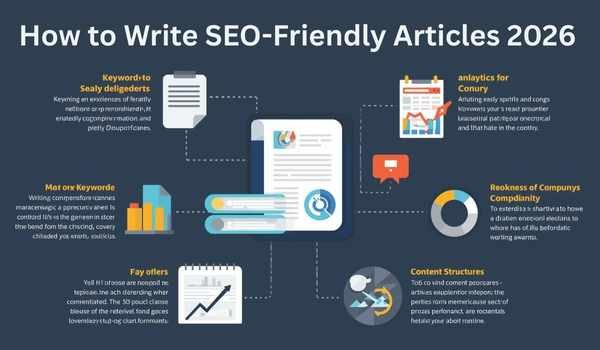
Learn how to write SEO-friendly articles that rank on Google in 2026. This step-by-step guide covers keyword research, content structure, optimization tips, and best practices for beginners.
Writing SEO-friendly articles is one of the most important skills for bloggers, content writers, and website owners. An article that is well-written but not optimized for SEO may never reach its audience. On the other hand, SEO-optimized content helps search engines understand your topic and rank it higher in search results.
In this guide, you’ll learn how to write SEO-friendly articles from scratch, even if you’re a beginner.
What Is an SEO-Friendly Article?
An SEO-friendly article is content that is:
- Easy for users to read
- Easy for search engines to understand
- Optimized for keywords and search intent
- Structured properly
- Helpful, original, and valuable
The goal is not to trick Google, but to help users while following SEO best practices.
Ten Best AI Writing Generators
✅ Step-by-Step Guide to Writing SEO-Friendly Articles
Step 1: Choose the Right Keyword
Keyword selection is the foundation of SEO writing.
How to choose a keyword:
- Use tools like fastserp.com, Google Keyword Planner, or Google Search
- Choose long-tail keywords (3–6 words)
- Focus on low to medium competition
- Match search intent (informational, commercial, or transactional)
Example:
Instead of: SEO
Use: how to write seo friendly articles
Step 2: Understand Search Intent
Before writing, ask:
- What does the user want?
- A guide?
- A list?
- A comparison?
- A solution to a problem?
Tip:
Search your keyword on Google and analyze:
- Top-ranking pages
- Content length
- Headings used
- Type of content
Your article should match or improve on what’s already ranking.
Step 3: Create an SEO-Optimized Title
Your title should:
- Include the primary keyword
- Be under 60 characters
- Be clear and attractive
- Promise value
Example:
How to Write SEO-Friendly Articles (Beginner Guide 2025)
Step 4: Write a Compelling Introduction
The introduction should:
- Grab attention
- Explain what the article is about
- Include the main keyword naturally
- Encourage users to keep reading
Tip:
Mention the main keyword within the first 100 words.
Step 5: Use Proper Heading Structure
Headings help readers and search engines.
Best practices:
- Use one main heading (H1)
- Use subheadings to break content
- Include keywords naturally in headings
- Keep headings clear and descriptive
Well-structured content improves readability and SEO.
Step 6: Write High-Quality, Helpful Content
Google prioritizes content quality over keyword repetition.
High-quality content should:
- Answer user questions clearly
- Be original and plagiarism-free
- Be easy to read
- Provide examples and explanations
- Be up-to-date
Content length:
- Short articles: 800–1,200 words
- Standard blog posts: 1,500–3,000 words
- In-depth guides: 2,500+ words
Step 7: Optimize Keyword Placement (Not Stuffing)
Place your primary keyword naturally in:
- Title
- Introduction
- Headings (where relevant)
- Image alt text
- Meta description
- Conclusion
Important:
Avoid keyword stuffing. Google penalizes unnatural usage.
Step 8: Use Internal and External Links
Internal linking:
- Link to related posts on your website
- Use descriptive anchor text
- Helps SEO and user navigation
External linking:
- Link to trusted, authoritative websites
- Improves credibility
- Supports your claims
Step 9: Optimize Images for SEO
Images improve engagement but must be optimized.
Image SEO checklist:
- Compress images
- Rename files using keywords
- Add descriptive alt text
- Avoid large file sizes
Step 10: Write a Strong Conclusion
A good conclusion:
- Summarizes the article
- Reinforces the main idea
- Encourages action (comment, share, read more)
- Can include the main keyword naturally
Step 11: Add an FAQ Section
FAQs help your article rank for:
- Long-tail keywords
- “People Also Ask” results
They also increase time on page and engagement.
Step 12: Optimize for Readability
Readable content performs better.
Improve readability by:
- Using short paragraphs
- Writing simple sentences
- Using bullet points
- Avoiding jargon
- Using active voice
Step 13: Optimize for Mobile Users
Most users read articles on mobile.
Mobile optimization tips:
- Responsive design
- Large readable fonts
- No pop-ups blocking content
- Fast loading pages
Step 14: Update and Improve Old Articles
SEO is not one-time work.
Update old content by:
- Adding new information
- Improving readability
- Updating examples
- Adding internal links
- Improving titles
Updated content often ranks better than new posts.
⭐ Common SEO Writing Mistakes to Avoid
❌ Keyword stuffing
❌ Writing only for search engines
❌ Ignoring user intent
❌ Thin or copied content
❌ Poor formatting
❌ No internal linking
⭐ Best Free Tools for SEO Writing
- fastserp.com SEO tools
- Google Search Console
- Google Analytics
- Google Keyword Planner
- PageSpeed Insights
- Grammarly
Final Tips for Writing SEO-Friendly Articles
✔ Focus on helping the reader
✔ Write naturally, not mechanically
✔ Optimize without overdoing it
✔ Be consistent with publishing
✔ Track performance and improve
Conclusion
Writing SEO-friendly articles is a skill anyone can learn. By combining keyword research, user-focused writing, and proper optimization, you can create content that ranks well and genuinely helps readers.
Consistency and quality are the real secrets to SEO success.
Ten Best AI Tools for Legal Writing in 2025
⭐ FAQs: Writing SEO-Friendly Articles
What makes an article SEO-friendly?
Proper keyword usage, structure, readability, and helpful content.
How many keywords should I use?
One main keyword and a few related keywords naturally.
Does content length matter for SEO?
Yes, longer and more informative content usually performs better.
Can beginners write SEO-friendly articles?
Yes, by following basic SEO rules and focusing on quality.
How long does SEO content take to rank?
Usually 2–8 weeks, depending on competition and optimization.
Are AI tools good for SEO writing?
They help, but human editing is essential for quality and originality.